

Developing a Better Brain-Controlled Exoskeleton Arm
Aarav Sharma is changing lives with brains, hard work, and engineering. And he hasn’t even graduated high school yet.

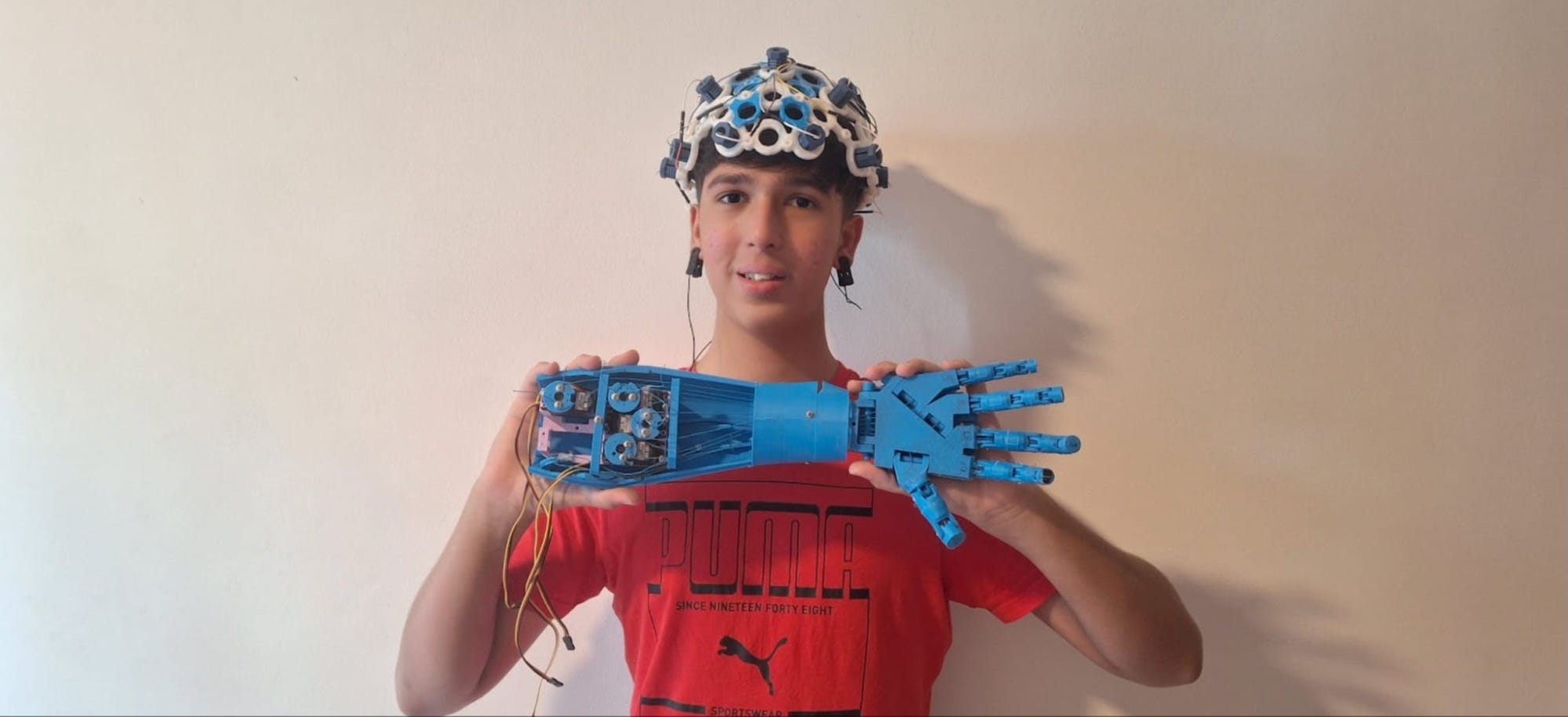
Sharma is no stranger to making, but his biggest project is a BCI arm that he began working on at age 14. The brain-controlled arm was designed to allow people with motor difficulty to navigate life a bit easier.
He realized it was a project worth working on after a trip to Singapore with SG Enable (an agency for disability and inclusion) where he saw close-up the difficulty people had who had trouble using their arms. While his device isn’t meant to be a total replacement, he hopes it will still be useful for certain tasks.
Controlling an arm is a challenge, but brain-control looked like the right way to go (as seems to be the case with these things), and thankfully OpenBCI was willing to sponsor his experiments.
Still, getting a reliable control signal from the headset took some work:
I initially detected basic movements such as eye blinks and electromyography (EMG) to better understand the field of Brain Computer Interfaces. I continued doing this until I managed to successfully identify the user concentration state, such as whether they are concentrated or distracted, and I planned to route these signals to control the exoskeleton arm.
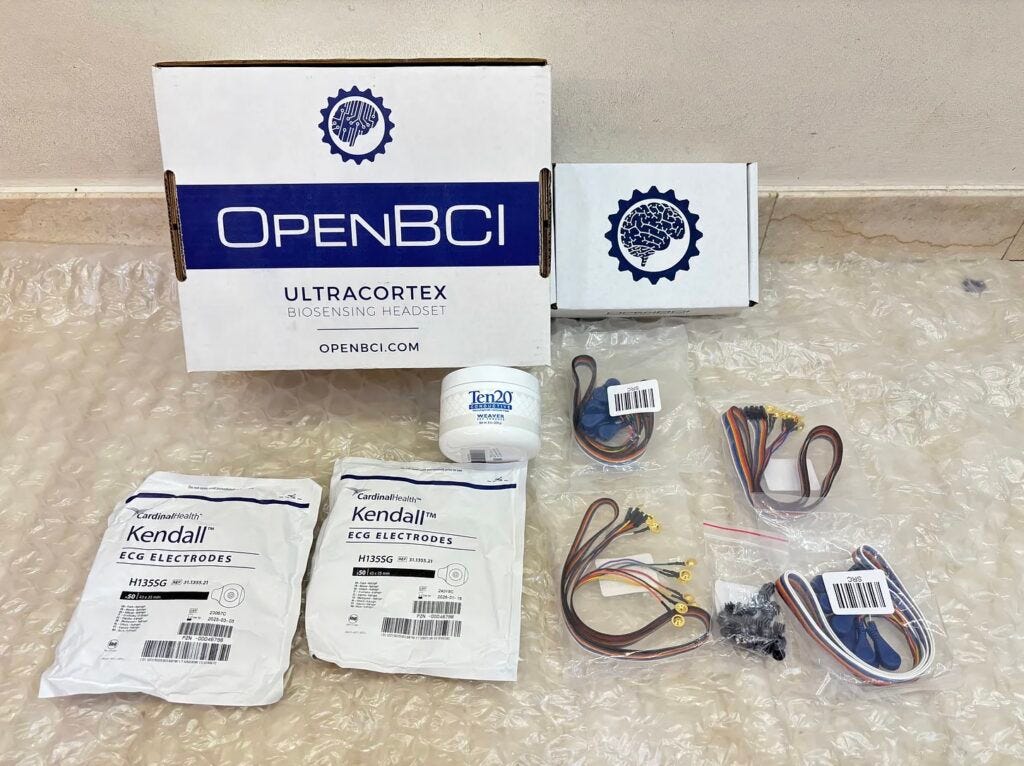
While an early version was controlled by those EMG muscle signals, he kept working with the headset and until it responded to concentration directly. In the latest version, a user wears an OpenBCI headset, a python script decides whether to open or close the hand and sends instructions to a Raspberry Pi, which finally commands the motors to turn.
The joints are powered by positional servo motors pulling badminton racket strings, which turned out to be a better fit than fishing line. The arm itself was modeled in Fusion 360 and 3D printed on a Flashforge Adventurer 5M Pro.
He’s experimenting with various machine learning models, including a Support Vector Machine (SVM) model, to improve the input, which has allowed more degrees of movement. So far he’s up to six different motions.
Aarav Sharma’s BCI exoskeleton arm performing six different motions.
As a result of all these efforts, he was invited to speak at Web Summit 2025 in Portugal, one of the world’s largest technology conferences, and had the opportunity to speak with CEOs from companies including Red Bull Racing, the Mercedes F1 Team, Lyft, and Lovable. He was also featured on Career Ladder for another project. See if you can guess what.
His work was featured on BusinessCloud. You can also learn more on LinkedIn and on his personal site.