

The Maker Movement: A Timeline
Events from the 1970's to 2026 that helped define and shape the Maker Movement

For the opening of the East Bay Makers Club, our team put together a timeline of the Maker Movement as a large poster for a wall on the new makerspace. Credit to Gillian Mutti for the text and Juliann Brown for the design.
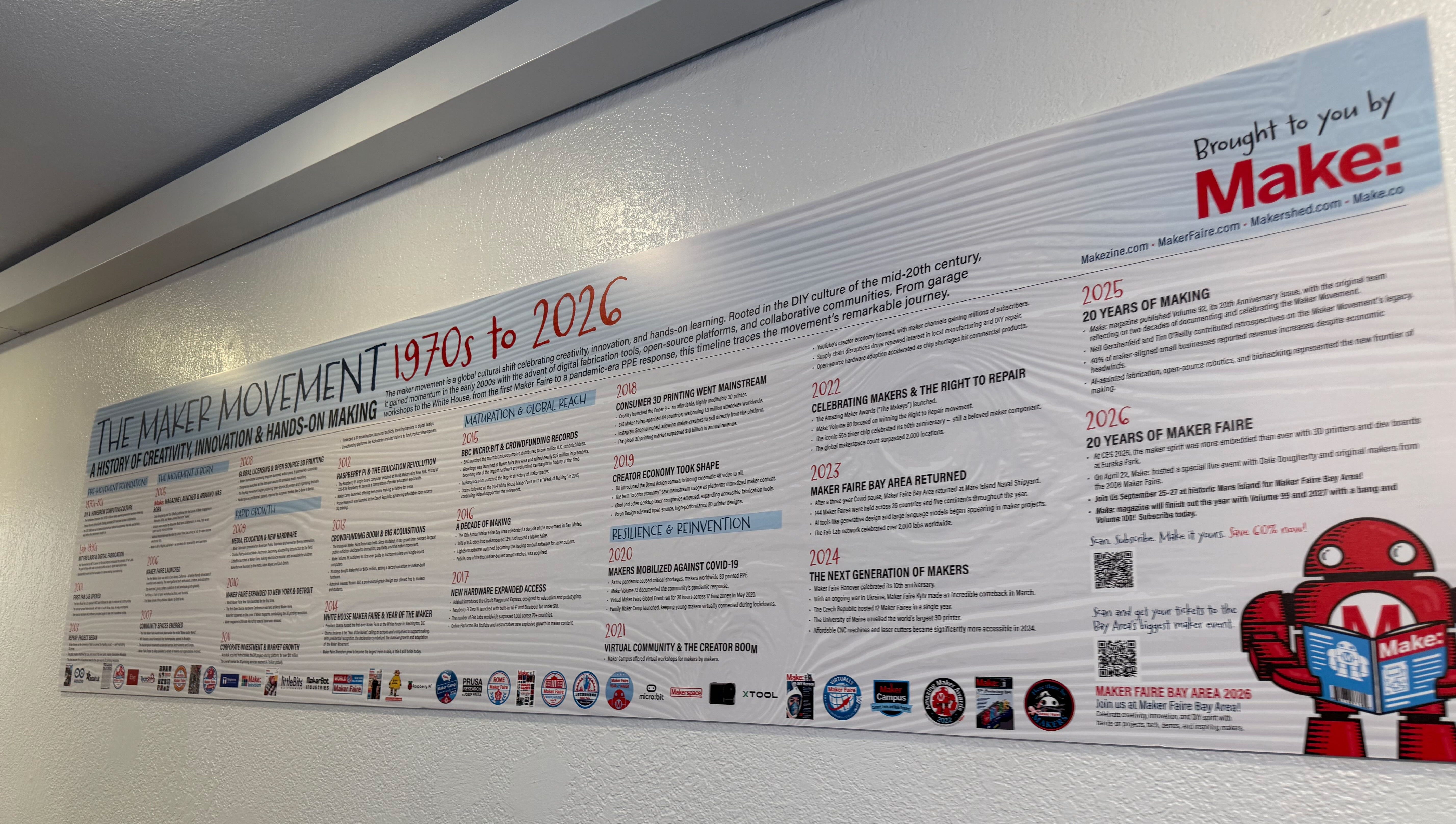
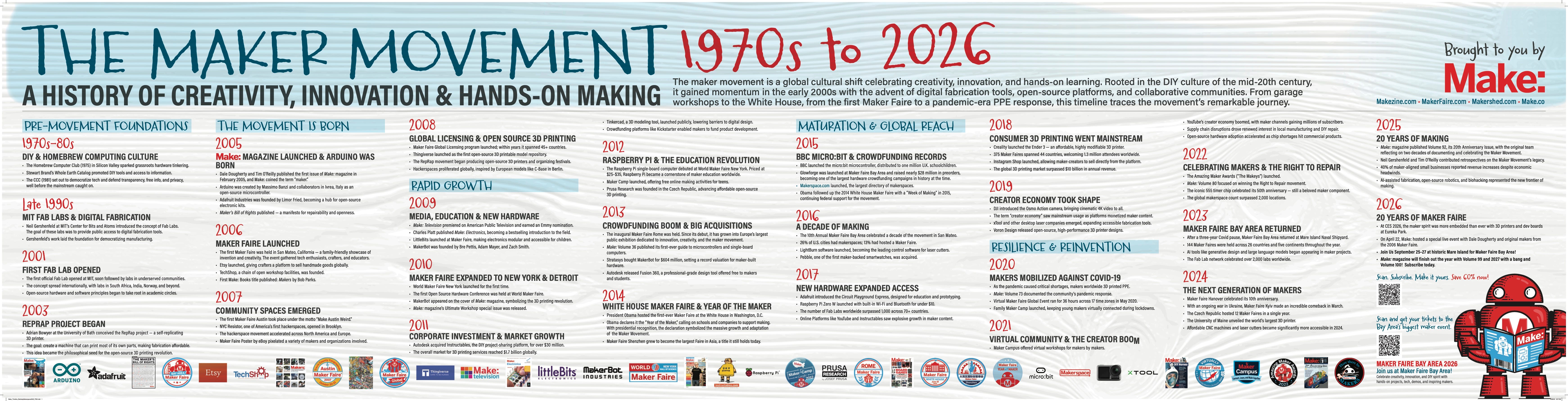
Here is the text of the poster followed by a JPG and PDF image of the poster. Feel free to suggest additions in the comments below, create your own version of the timeline, and share it in your own makerspace.
THE MAKER MOVEMENT 1970s to 2026
The Maker Movement is a global cultural shift celebrating creativity, innovation, and hands-on learning. Rooted in the DIY culture of the mid-20th century, it gained momentum in the early 2000s with the advent of digital fabrication tools, open-source platforms, and collaborative communities. From garage workshops to the White House, from the first Maker Faire to a pandemic-era PPE response, this timeline traces the movement’s remarkable journey.
PRE-MOVEMENT FOUNDATIONS
1970s–80s
DIY & Homebrew Computing Culture
The Homebrew Computer Club (1975) in Silicon Valley sparked grassroots hardware tinkering.
Stewart Brand’s Whole Earth Catalog promoted DIY tools and access to information.
The CCC (1981) set out to democratize tech and defend transparency, free info, and privacy, well before the mainstream caught on.
Late 1990s
MIT Fab Labs & Digital Fabrication
Neil Gershenfeld at MIT’s Center for Bits and Atoms introduced the concept of Fab Labs. The goal of these labs was to provide public access to digital fabrication tools.
Gershenfeld’s work laid the foundation for democratizing manufacturing.
2001
First Fab Lab Opened
The first official Fab Lab opened at MIT, soon followed by labs in underserved communities.
The concept spread internationally, with labs in South Africa, India, Norway, and beyond.
Open-source hardware and software principles began to take root in academic circles.
2003
RepRap Project Began
Adrian Bowyer at the University of Bath conceived the RepRap project — a self-replicating 3D printer.
The goal: create a machine that can print most of its own parts, making fabrication affordable.
This idea became the philosophical seed for the open-source 3D printing revolution.
THE MOVEMENT IS BORN
2005
Make: Magazine Launched & Arduino was Born
Dale Dougherty and Tim O’Reilly published the first issue of Make: magazine in February 2005, and Make: coined the term “maker.”
Arduino was created by Massimo Banzi and collaborators in Ivrea, Italy as an open-source microcontroller.
Adafruit Industries was founded by Limor Fried, becoming a hub for open-source electronic kits.
Maker’s Bill of Rights published — a manifesto for repairability and openness.
2006
Maker Faire Launched
The first Maker Faire was held in San Mateo, California — a family-friendly showcase of invention and creativity. The event gathered tech enthusiasts, crafters, and educators.
Etsy launched, giving crafters a platform to sell handmade goods globally.
TechShop, a chain of open workshop facilities, was founded.
First Make: Books title published: Makers by Bob Parks.
2007
Community Spaces Emerged
The first Maker Faire Austin took place under the motto “Make Austin Weird.”
NYC Resistor, one of America’s first hackerspaces, opened in Brooklyn.
The hackerspace movement accelerated across North America and Europe.
Maker Faire Poster by eBoy pixelated a variety of makers and organizations involved.
2008
Global Licensing & Open Source 3D Printing
Maker Faire Global Licensing program launched; within years it spanned 45+ countries.
Thingiverse launched as the first open-source 3D printable model repository.
The RepRap movement began producing open-source 3D printers and organizing festivals.
Hackerspaces proliferated globally, inspired by European models like C-Base in Berlin.
RAPID GROWTH
2009
Media, Education & New Hardware
Make: Television premiered on American Public Television and earned an Emmy nomination.
Charles Platt published Make: Electronics, becoming a bestselling introduction to the field.
LittleBits launched at Maker Faire, making electronics modular and accessible for children.
MakerBot was founded by Bre Pettis, Adam Mayer, and Zach Smith.
2010
Maker Faire Expanded to New York & Detroit
World Maker Faire New York launched for the first time.
The first Open Source Hardware Conference was held at World Maker Faire.
MakerBot appeared on the cover of Make: magazine, symbolizing the 3D printing revolution.
Make: magazine’s Ultimate Workshop special issue was released.
2011
Corporate Investment & Market Growth
Autodesk acquired Instructables, the DIY project-sharing platform, for over $30 million.
The overall market for 3D printing services reached $1.7 billion globally.
Tinkercad, a 3D modeling tool, launched publicly, lowering barriers to digital design.
Crowdfunding platforms like Kickstarter enabled makers to fund product development.
2012
Raspberry Pi & the Education Revolution
The Raspberry Pi single-board computer debuted at World Maker Faire New York. Priced at $25–$35, Raspberry Pi became a cornerstone of maker education worldwide.
Maker Camp launched, offering free online making activities for teens.
Prusa Research was founded in the Czech Republic, advancing affordable open-source 3D printing.
2013
Crowdfunding Boom & Big Acquisitions
The inaugural Maker Faire Rome was held. Since its debut, it has grown into Europe’s largest public exhibition dedicated to innovation, creativity, and the maker movement.
Make: Volume 36 published its first-ever guide to microcontrollers and single-board computers.
Stratasys bought MakerBot for $604 million, setting a record valuation for maker-built hardware.
Autodesk released Fusion 360, a professional-grade design tool offered free to makers and students.
2014
White House Maker Faire & Year of the Maker
President Obama hosted the first-ever Maker Faire at the White House in Washington, D.C.
Obama declares it the “Year of the Maker,” calling on schools and companies to support making. With presidential recognition, the declaration symbolized the massive growth and adaptation of the Maker Movement.
Maker Faire Shenzhen grew to become the largest Faire in Asia, a title it still holds today.
MATURATION & GLOBAL REACH
2015
BBC micro:bit & Crowdfunding Records
BBC launched the micro:bit microcontroller, distributed to one million U.K. schoolchildren.
Glowforge was launched at Maker Faire Bay Area and raised nearly $28 million in preorders, becoming one of the largest hardware crowdfunding campaigns in history at the time.
Makerspace.com launched, the largest directory of makerspaces.
Obama followed up the 2014 White House Maker Faire with a “Week of Making” in 2015, continuing federal support for the movement.
2016
A Decade of Making
The 10th Annual Maker Faire Bay Area celebrated a decade of the movement in San Mateo.
26% of U.S. cities had makerspaces; 13% had hosted a Maker Faire.
LightBurn software launched, becoming the leading control software for laser cutters.
Pebble, one of the first maker-backed smartwatches, was acquired.
2017
New Hardware Expanded Access
Adafruit introduced the Circuit Playground Express, designed for education and prototyping.
Raspberry Pi Zero W launched with built-in Wi-Fi and Bluetooth for under $10.
The number of Fab Labs worldwide surpassed 1,000 across 70+ countries.
Online Platforms like YouTube and Instructables saw explosive growth in maker content.
2018
Consumer 3D Printing went Mainstream
Creality launched the Ender 3 — an affordable, highly modifiable 3D printer.
375 Maker Faires spanned 44 countries, welcoming 1.3 million attendees worldwide.
Instagram Shop launched, allowing maker-creators to sell directly from the platform.
The global 3D printing market surpassed $10 billion in annual revenue.
2019
Creator Economy Took Shape
DJI introduced the Osmo Action camera, bringing cinematic 4K video to all.
The term “creator economy” saw mainstream usage as platforms monetized maker content.
xTool and other desktop laser companies emerged, expanding accessible fabrication tools.
Voron Design released open-source, high-performance 3D printer designs.
RESILIENCE & REINVENTION
2020
Makers Mobilized Against COVID-19
As the pandemic caused critical shortages, makers worldwide 3D printed PPE.
Make: Volume 73 documented the community’s pandemic response.
Virtual Maker Faire Global Event ran for 36 hours across 17 time zones in May 2020.
Family Maker Camp launched, keeping young makers virtually connected during lockdowns.
2021
Virtual Community & the Creator Boom
Maker Campus offered virtual workshops for makers by makers.
YouTube’s creator economy boomed, with maker channels gaining millions of subscribers.
Supply chain disruptions drove renewed interest in local manufacturing and DIY repair.
Open-source hardware adoption accelerated as chip shortages hit commercial products.
2022
Celebrating Makers & the Right to Repair
The Amazing Maker Awards (“The Makeys”) launched.
Make: Volume 80 focused on winning the Right to Repair movement.
The iconic 555 timer chip celebrated its 50th anniversary — still a beloved maker component.
The global makerspace count surpassed 2,000 locations.
2023
Maker Faire Bay Area Returned
After a three-year Covid pause, Maker Faire Bay Area returned at Mare Island Naval Shipyard.
144 Maker Faires were held across 26 countries and five continents throughout the year.
AI tools like generative design and large language models began appearing in maker projects.
The Fab Lab network celebrated over 2,000 labs worldwide.
2024
The Next Generation of Makers
Maker Faire Hanover celebrated its 10th anniversary.
With an ongoing war in Ukraine, Maker Faire Kyiv made an incredible comeback in March.
The Czech Republic hosted 12 Maker Faires in a single year.
The University of Maine unveiled the world’s largest 3D printer.
Affordable CNC machines and laser cutters became significantly more accessible in 2024.
2025
20 Years of Making
Make: magazine published Volume 92, its 20th Anniversary Issue, with the original team reflecting on two decades of documenting and celebrating the Maker Movement.
Neil Gershenfeld and Tim O’Reilly contributed retrospectives on the Maker Movement’s legacy.
40% of maker-aligned small businesses reported revenue increases despite economic headwinds.
AI-assisted fabrication, open-source robotics, and biohacking represented the new frontier of making.
2026
20 Years of Maker Faire
At CES 2026, the maker spirit was more embedded than ever with 3D printers and dev boards at Eureka Park.
On April 22, Make: hosted a special live event with Dale Dougherty and original makers from the 2006 Maker Faire.

Join Us September 25–27 at historic Mare Island for Maker Faire Bay Area!
The timeline is a good reminder that the maker movement never actually needed permission from anyone. That’s the part I keep relearning the hard way: build the thing first, then find out if it matters to someone else.