

What They Do in the Shadows
Manual Cinema created former President Obama’s favorite exhibit at his own museum, and may be bringing their dark magic to your town

This is an expanded version of an article that appeared in Make: Vol 98.
“What the #%@$ was that?”
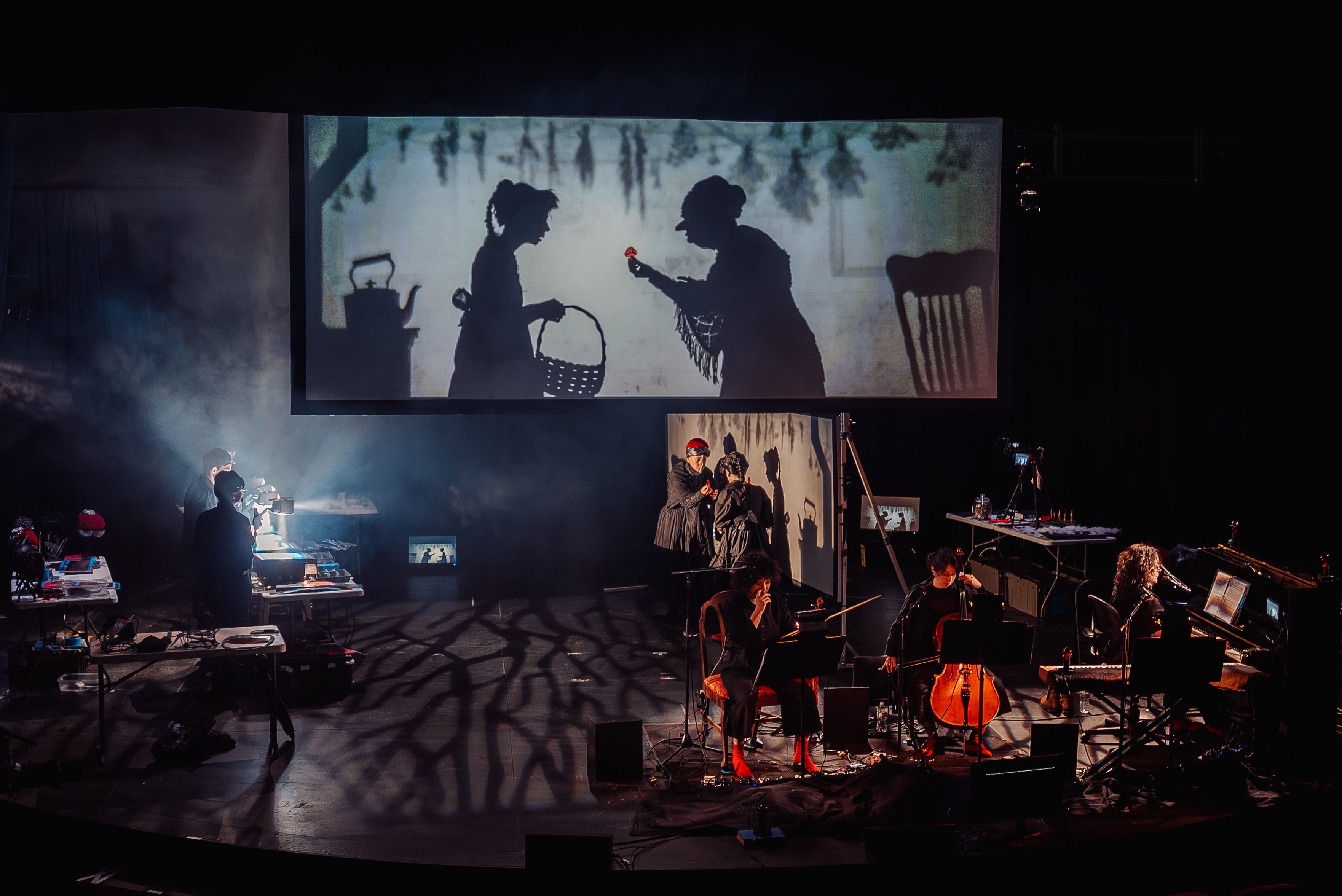
I’m standing outside UC Berkeley’s Zellerbach Hall, trying to wrap my mind around what I just saw. In the days that follow, I describe Manual Cinema’s performance of The 4th Witch to people, but it comes out as a word salad: Shadow puppets, and overhead projectors, but with actors and crazy props, and live music, on a giant screen, and . . . and. . . .
“I like to describe it as watching a movie live before your eyes,” says Manual Cinema co-artistic director Julia Miller, throwing me a lifeline when we talk a few weeks later. “When you say ‘puppetry’ — and we are a puppet company — people have pretty specific connotations. They often imagine a talking sock, a Sesame Street–type of fuzzy puppet. Even within the Manual Cinema universe we have different ways of describing it, but I would say it’s ‘cinematic shadow puppetry.’”
A large screen hangs above the stage where the audience watches the show, while below it’s all being made in real time. Four overhead projectors — the kind still being used in classrooms across the country — are operated by puppeteers to cast shadows that composite into one master image. Meanwhile, costumed performers are integrating live action with the puppetry, and a music ensemble is scoring what is seen on screen.
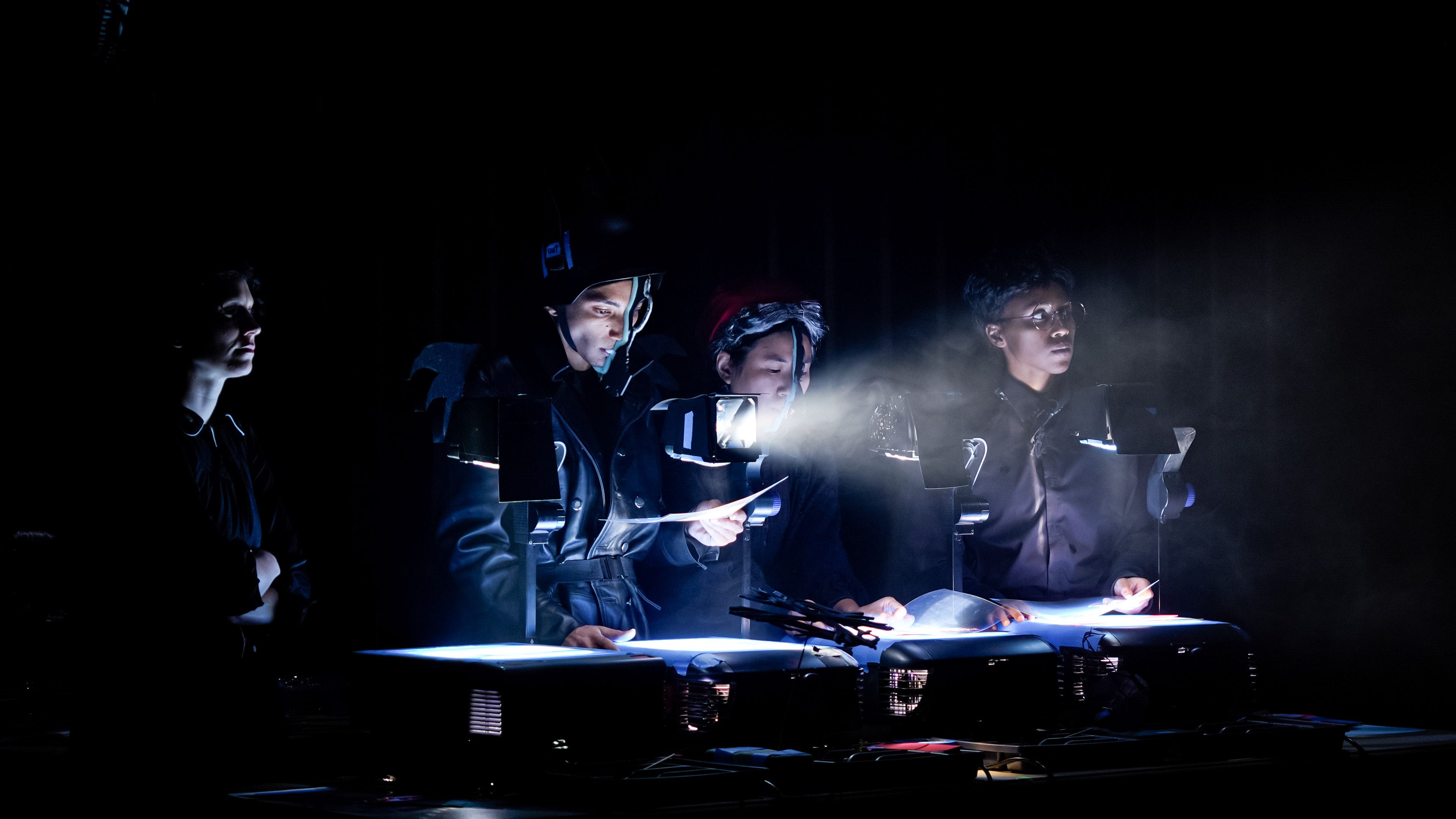
Oh, did I mention that the puppeteers are also the actors, so they’re constantly slipping in and out of costumes and cycling into the camera’s view, then ducking out to move their next puppet into place on the projector in a frenetic, synchronized whirlwind?
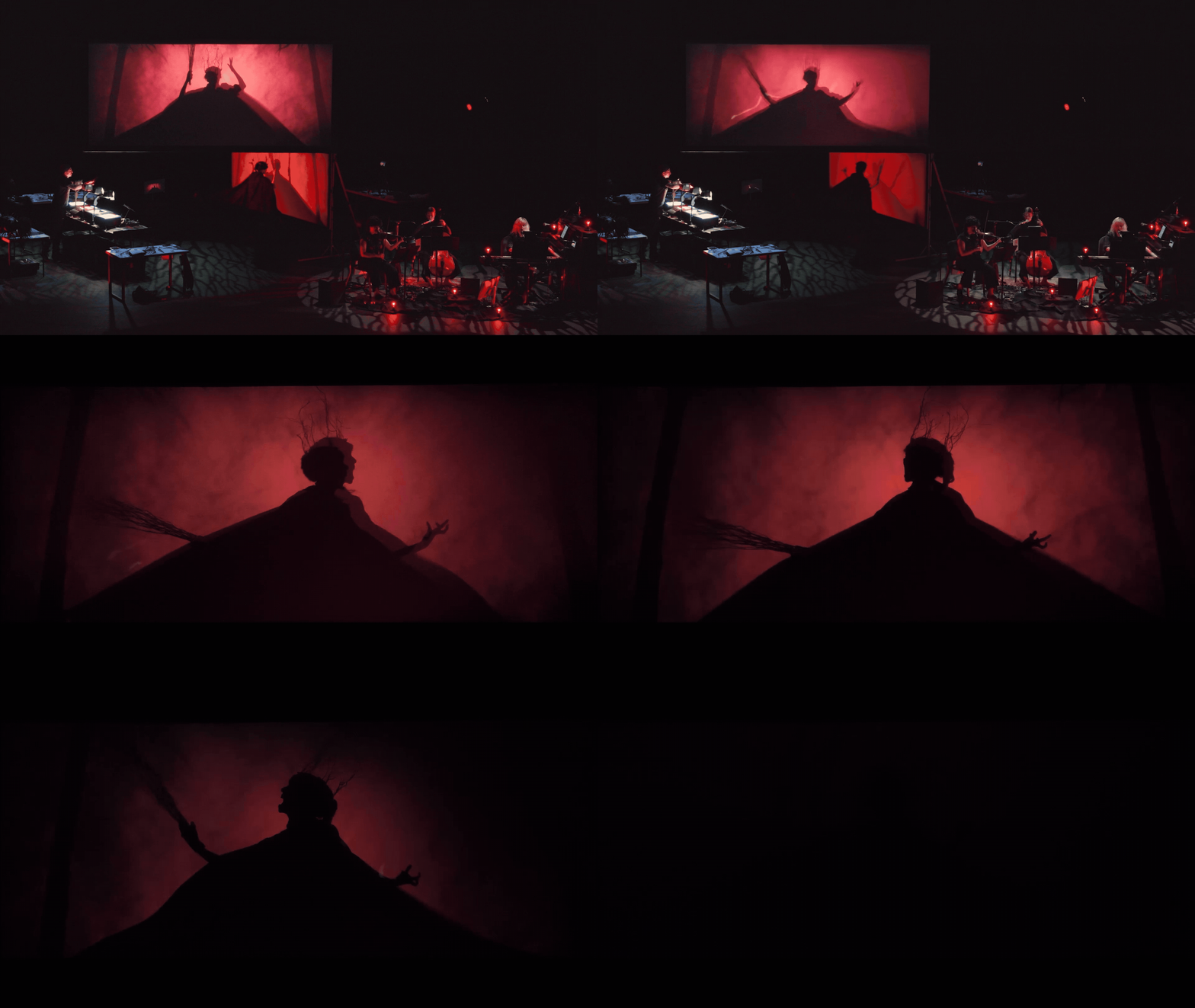
“It’s kind of like choose-your-own-adventure, as far as what you look at on stage,” says Miller. “You can watch the final image of the show on the screen above. You can watch the musicians play. You can watch the performers running around to the camera and back to the projector. And you can also try to figure out how we’re doing a special effect.”
Or, if you’re like me, your eyes will constantly bounce around the stage, trying to take it all in at once.
Playbill
Manual Cinema is a Chicago-based performance collective, with an emphasis on collective. Miller handles the marketing, but is quick to point out that she is just one of five co-artistic directors that include Drew Dir, Sarah Fornace, Ben Kauffman, and Kyle Vegter. In addition to their live performances, they’ve earned an Emmy for their video work on The Forger, a documentary short produced by The New York Times; created animation sequences in Jordan Peele’s 2021 film remake of Candyman; created and performed the visuals on Iron & Wine’s 2024 “Light Verse” tour; and most recently, created two animated films for the Obama Presidential Center Museum.
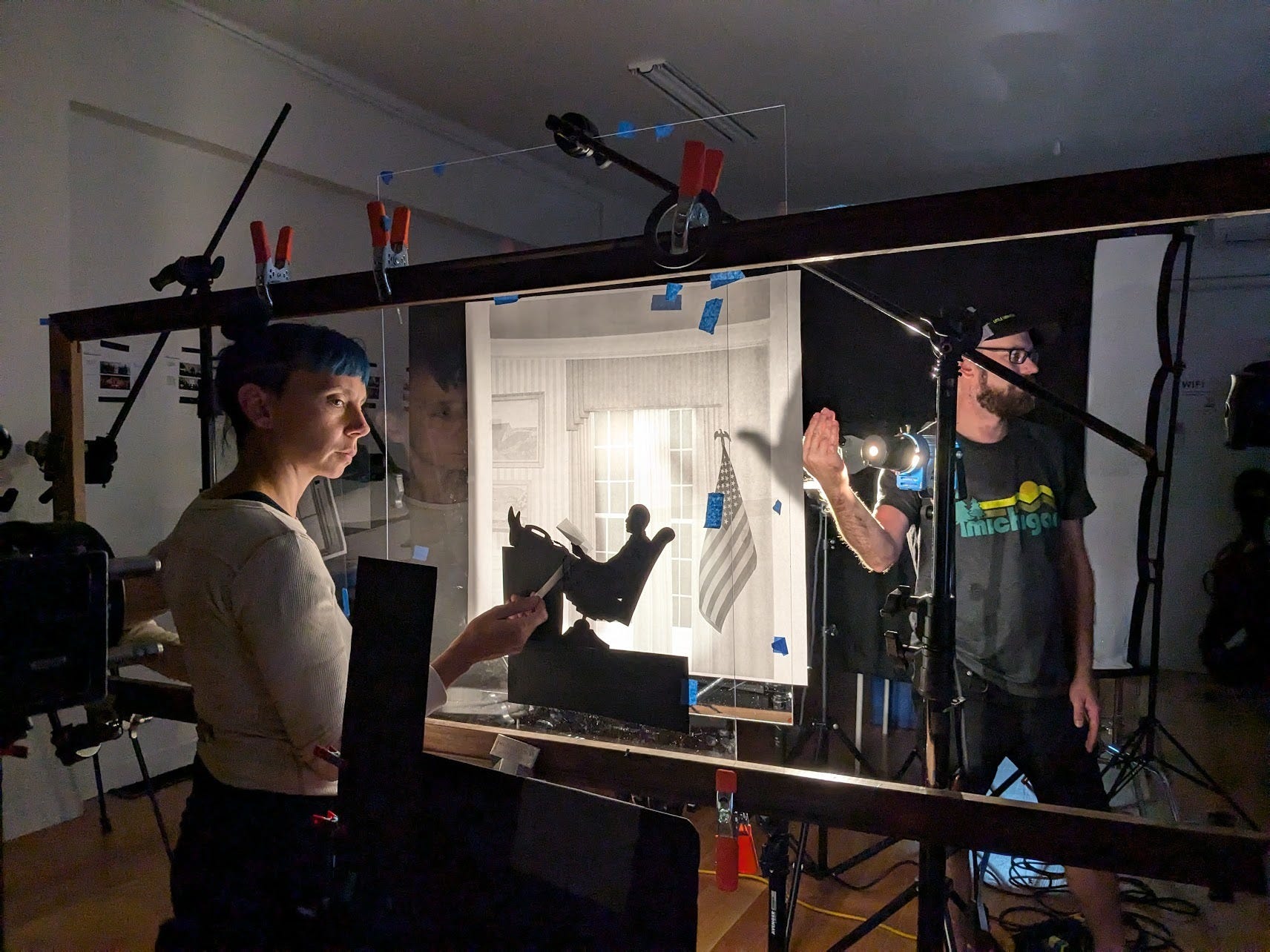
“When I was a kid, I was really into drawing and visual art and thought I was going to go to art school,” says Dir. “But then I was asked to paint a scenic backdrop for a high school theater production. And just the experience of being exposed to theater kids, I was like, ‘These people are great — they’re charming and funny and well-spoken, and the process of putting on a play is cool and exciting.’ When you’re a visual artist, your work is kind of solitary. But theater is all about collaboration and depending on one another, and it was so exciting.”
My Kind of Town
Miller was also drawn to the collaboration and camaraderie of theater in middle school and high school, then fully immersed herself in it through Boston University’s conservatory-esque theater arts program. “It was so weird being in the dorms — I remember there were girls going out that were all dressed up and I’ve literally been rolling around on the floor wearing workout-clothes-meets-pajamas as we study really abstract and experimental theater stuff,” shares Miller. “I felt ridiculous to be like, ‘I’m trying to free my natural voice,’ and they’re ... studying chemistry.”
After college, she trained with a theater company in New England, then moved to Chicago to do shows mostly because she didn’t want to be in New York or LA. One was with Redmoon Theater, which created overhead-projector puppetry for Swan Lake with the Chicago Symphony Orchestra. Miller was fascinated by its visual, nonverbal storytelling, and she took the puppet designer out for coffee hoping to get her trade secrets. “I asked, ‘What kind of paper do you use? What kind of tape? Tell me everything!’ and she said, ‘You can buy this stuff at Walgreens.’”
From there, it was fate: Miller’s landlord used to be a medical lecturer and still had an overhead projector in his garage. She asked a Redmoon Theater friend — future Manual Cinema co-artistic director Fornace — if she’d work on a new puppet show with her, but Fornace was already in a show and referred Miller to her partner, Dir. Miller and Dir created The Ballad of Lula del Rey, and the two of them performed it with a single projector.
The final principals fell into place when Miller messaged Kauffman and Vegter, a couple of acquaintances whose music she heard on their Facebook account. She asked about using their ambient music for The Ballad of Lula del Rey, and they not only agreed, but volunteered to write original music and create the show’s sound design.


“A guy I was dating was a violin maker, and he made us a bespoke shadow screen out of wood that was collapsible so it could fit in the trunk of my Toyota Corolla,” remembers Miller with a laugh. “That show was maybe 20 minutes long and we performed it at bars and loft spaces and anywhere people asked us to, and everyone helped out.
“And that’s how Manual Cinema was born.”
Exit, Pursued by a Bear
After 15 years, the folks at Manual Cinema have figured out a lot of things, including that being simple and scrappy is part of their ethos. One example of this is a clever effect that can make a character look like it’s moving very fast. In the past, they used a technique of moving a long strip of illustrated transparency across the projector. It works, but its duration and impact are limited by the physical length of the puppeteer’s wingspan, and how fast it can be moved across the projector.
Instead of thinking of a high-tech version, they simplified it. “We just needed to sell the idea of a moving landscape,” explains Dir. “So we cut up some paper to make it look like tree branches, and put it on a stick so it could be spun over the projector lens and look like passing background. It gives just enough of a suggestion of the effect that the audience’s imagination fills in the rest.”
That audience participation — where we aren’t spoon-fed realism and need to actively process visual and audio cues — is part of what makes this art so provocative. I ask Dir about other effects I noticed, and how much fun it is to theorize the mechanics of these visual tricks.
“We want to show you things that you’ve never seen before, moments of spectacle,” says Dir. “Sometimes that means showing you an ordinary object or story point like someone pouring water out of a kettle, but make it happen in an extraordinary way. We’ve found that the more realistic we make it, the less remarkable it feels. That’s where our theatrical background comes in, where you spread a piece of blue silk on stage and actors wave it around, and it represents the ocean. There are these simple acts of imagination that you ask the audience to take part in.”
Innovation and Exposition
More than 500 individual slides or paper puppets are used in a show like The 4th Witch, as well as utensil trays of delicate, tiny puppets that can measure half an inch. But one of the most transformative pieces is something created by Miller.
“I came up with the shadow masks with an eye on functionality,” says Miller. “As a performer I knew what I wanted it to do, and I knew as a maker how to figure it out.” A lot of shadow companies that use live actors will use “hats” with a facial silhouette extending to the side, so performers can cast a profile shadow while facing the screen to watch their movements. But Manual Cinema performers switch directions and move back and forth across the screen, and they need unimpeded vision to see the composite screen because they’re interacting with projections instead of real objects.
Miller’s solution was to create a two-dimensional mask worn only on her profile, so the performer’s profile is on the inside of the mask, and the character’s profile is on the outside of the mask and casts its shadow. It attaches in two places, at the top of the actor’s head and at the mouth, held in place by a custom-fitted mouthpiece made from InstaMorph, a moldable plastic. Filling the silhouette is simple foamcore board with a little piece of upholstery foam that presses against the face to prevent light from leaking through any gaps. “As a performer, the mask helps lock in your specificity of movement because it takes away a big expressive tool — your face — and encourages you to think about your movement in a different way by dropping expressiveness into your body. It’s like you’re puppeting yourself.”


Sharing the Wonder
When Manual Cinema goes on the road for a performance, they hold workshops led by Fornace that cater to that show’s audience — they often teach adults, but gear their presentation toward children if they’re performing a kid-friendly program like Leonardo! A Wonderful Show About a Terrible Monster. The workshops usually include two parts, the first of which teaches participants how to perform a piece of an existing Manual Cinema show, to learn the technical part of executing a sequence. The second is more sandbox: Fornace gives attendees a bunch of random puppets and slides and an “ingredients list” of things like “a surprise” or “a change of scale,” and they create their own story and work as an ensemble to perform it. A kind of self-selection occurs, where people naturally gravitate toward roles like directing or performing.
“It’s very fun to see their sense of wonder unlocked, as they see what we do and then see how they can do it, too,” says Miller. And that sharing of skills and tricks is baked into the puppetry community. When Manual Cinema was in its infancy, they had puppeteer mentors who taught them how to work an overhead projector and build different types of shadow puppets. They took those techniques and transformed them into Manual Cinema’s style.
“There’s a lot of people out there making shadow work and experimental theater who have partnered with us, and hopefully took something from how we do it and brought it into their own work,” adds Dir.
Coming Into Focus
While Manual Cinema seems to have mastered their craft, they still find new innovations to push boundaries. Newer productions like Frankenstein place performers on the camera side of the compositing screen, so projector shadows are still used to create backgrounds and effects, but a live actor performs in the foreground. The Frankenstein story and author Mary Shelley’s creation of the book are both part of this production, and Manual Cinema uses different visual language to separate those story lines: Mary Shelley is exclusively in shadow puppetry, while Victor Frankenstein and his monster are in shadow but also on camera in a style that evokes black-and-white silent films.

Similarly, their experience on Iron & Wine’s concert tour was a departure from Manual Cinema’s tightly woven narratives and more an experiment in capturing how a song feels and creating a visual background for the music to live inside. And their adaptation of A Christmas Carol is performed in the style of Victorian toy theater, where people moved miniature figurines.
“At the end of the day, it’s not about the tools you’re using,” says Dir. “It’s about how you’re using them. We’re not the first company to use overhead projectors in this way. Nothing we use on stage is a secret, or a weird piece of technology. It’s all stuff that you may have around your house, but we hopefully combine it in a way where it becomes more than the sum of its parts.”